
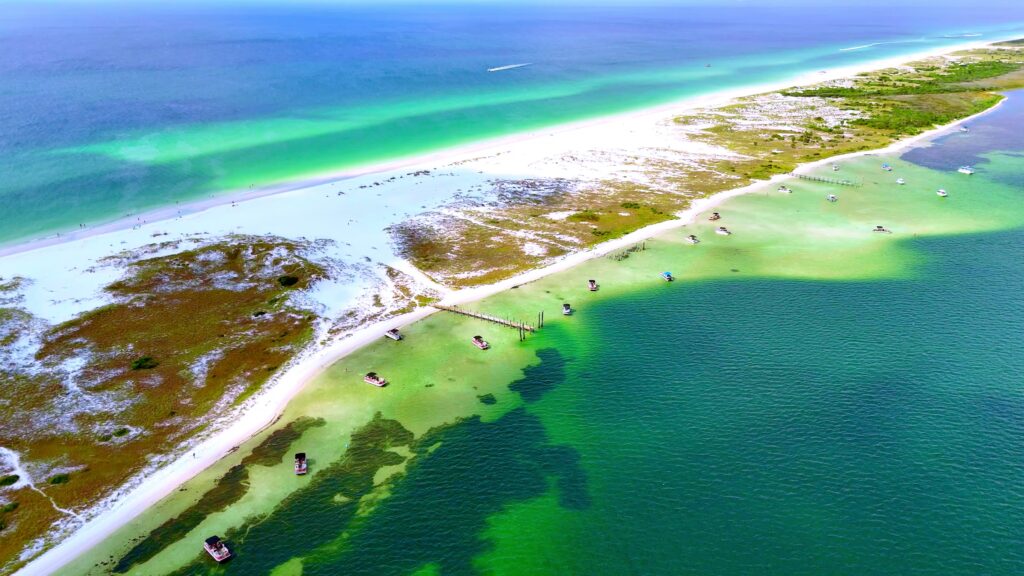
If you are visiting Panama City Beach, chances are you have already heard someone mention Shell Island. Located just across the water from St. Andrews State Park, this beautiful stretch of undeveloped coastline is one of the most unique places to experience in Panama City Beach. There are no hotels, restaurants, paved roads, condos or souvenir shops—just miles of white sand, emerald water, dunes, coastal vegetation and wildlife. Shell Island stretches for roughly seven miles between the Gulf and St. Andrews Bay and remains largely undeveloped, giving visitors a chance to experience a very different side of Panama City Beach.
But there is one important thing every first-time visitor should understand: you cannot drive to Shell Island. Getting there is part of the adventure. You can take a ferry, join a Shell Island snorkeling or dolphin tour, rent a pontoon boat, kayak over in suitable conditions, or arrive on your own boat. Which option is best depends on how much freedom you want, how long you plan to stay, whether you want to snorkel or look for dolphins, and—especially for families—how much the entire day will actually cost.
What Is Shell Island?
Shell Island is part of the natural barrier-island system protecting St. Andrews Bay. Today, it is associated with St. Andrews State Park and the St. Andrews State Park Aquatic Preserve. Its Gulf side offers long stretches of white sand and open emerald water, while the protected bay side contains shallower water, tidal flats and important seagrass habitat. The St. Andrews Bay system is exceptionally diverse; Florida DEP notes that the bay contains more than 2,100 recorded marine-dependent species and the largest expanse of ecologically valuable seagrass beds in the Florida Panhandle.
That combination of Gulf, bay, sandbars, grass flats and protected shoreline is one reason a trip to Shell Island can feel completely different depending on where you stop. One family may spend the afternoon swimming on a quiet sandy beach, while another is snorkeling over grass beds looking for marine life, and another is anchored offshore watching dolphins travel through St. Andrews Bay.
A Little History of Shell Island
Shell Island has an interesting history that many visitors never hear about. The area was visited by Native Americans centuries ago, when the surrounding waters provided abundant shellfish. What we now call Shell Island was originally part of Lands End Peninsula. According to Florida State Parks, the modern island was created when the Gulf-Bay Pass was dredged in the 1930s, separating the land and creating the navigational entrance between St. Andrews Bay and the Gulf.
The surrounding area also has a military history. During World War II, St. Andrews State Park’s land served as a military reservation, and two 155mm gun positions were constructed near the pass as part of the area’s harbor defenses. Remnants of those installations can still be found within St. Andrews State Park today.
Shell Island itself has remained remarkably undeveloped. That is a big part of its appeal. There are no rows of beachfront buildings waiting when you arrive. Instead, you see dunes covered in sea oats, coastal scrub, nesting birds, sea turtles and miles of natural shoreline. It is essentially a glimpse of what much of Florida’s Gulf Coast looked like before large-scale development.
Hurricane Michael Changed Shell Island
Shell Island is a barrier island, which means change is part of its natural story. Storms, currents, tides and shifting sand continually reshape the shoreline. But Hurricane Michael in October 2018 produced particularly dramatic changes throughout this part of the Florida Panhandle.
The Category 5 hurricane caused major damage to St. Andrews State Park and Shell Island. USGS documented erosion, dune overwash and inundation around St. Andrews following the storm. On Shell Island, docks and boardwalks were severely damaged and initially unusable. The Capt. Anderson III dock and boardwalk on Shell Island, which had been used for decades, required reconstruction before reopening for public access in June 2019.
Hurricane Michael also significantly altered parts of the nearby jetty system. Sections that once provided greater protection became submerged or changed substantially after the storm. It is a powerful reminder that Shell Island isn’t a manufactured attraction—it is a living barrier island that continues to be shaped by the Gulf.
How Do You Get to Shell Island?
There is no bridge to Shell Island, so every visit requires some form of water transportation. The three most popular choices for visitors are taking the ferry, booking a guided snorkeling/dolphin tour, or renting a pontoon boat.
Each provides a very different experience.
Option 1: Take the Shell Island Ferry
The official Shell Island Ferry operates from St. Andrews State Park and provides straightforward transportation to and from the island. The boat ride itself takes approximately 15 minutes, and visitors can bring coolers, chairs, umbrellas and beach gear. Depending on the seasonal schedule, you can stay for several hours as long as you return in time for the final ferry.
The ferry makes sense for visitors whose main goal is simply getting to the beach. You don’t have to drive a boat, navigate the bay or worry about anchoring.
There are trade-offs, however. You’re operating around a schedule, you have to carry everything you need, and you’re primarily being transported from Point A to Point B. The ferry’s official information also notes that its drop-off is about 2.2 miles down the island at the State Park docks rather than directly behind the main jetty area.
For couples or solo travelers who simply want a quiet beach day, that can be perfectly adequate. For families looking for dolphins, snorkeling, paddleboarding and several different areas of Shell Island, it is worth comparing the total cost with the other options before automatically choosing the ferry.
Option 2: Take a Shell Island Snorkeling & Dolphin Tour
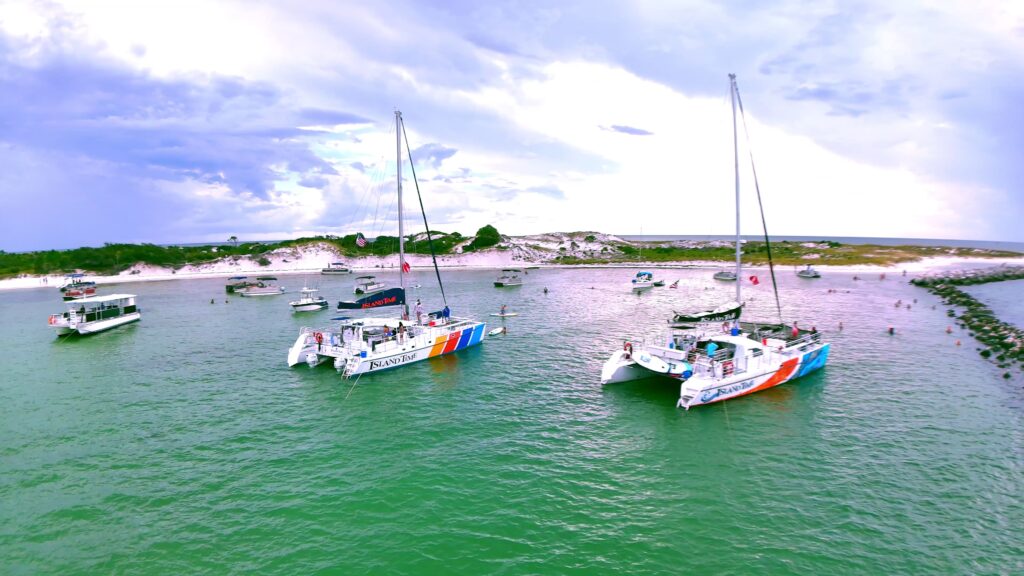
A guided tour turns transportation into part of the experience. Instead of simply crossing over and being dropped off, a snorkeling cruise can combine dolphin watching, sightseeing, snorkeling, Shell Island and time on the water into one outing.
For example, Island Time Sailing’s Shell Island Snorkel & Dolphin Catamaran Cruise is approximately three hours and currently lists pricing from $49 for adults and $39 for children ages 3–12, with snorkeling equipment, flotation jackets and paddleboards included. The trip cruises through St. Andrews Bay and the jetties while looking for dolphins before stopping for snorkeling and water activities around Shell Island.
For a family of four with two adults and two children, that’s approximately $176 before taxes/fees, based on currently published pricing. Instead of paying only for transportation, you’re paying for a captain and crew, dolphin sightseeing, snorkeling equipment, paddleboards and a structured three-hour experience.
That makes guided tours particularly attractive to first-time visitors, families who don’t want to operate their own boat, and anyone who wants to experience several of the things Shell Island is known for without planning the logistics themselves.
Option 3: Rent a Pontoon Boat
For families and groups of four or more, this is where the math gets interesting.
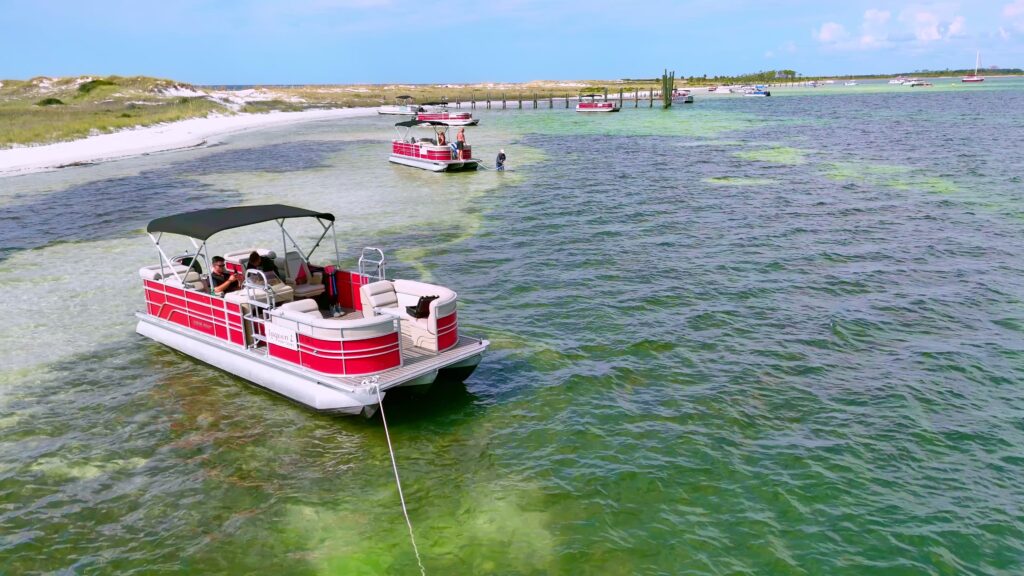
A pontoon rental gives you something neither a ferry nor a public tour can provide: complete freedom over your day. You choose where you stop, how long you swim, when you eat, which beach you visit and when you’re ready to head back.
Lagoon Pontoons currently advertises half-day rentals beginning around $179 for a 70 HP pontoon and $199 for several 90 HP options, with capacities up to 12 passengers. Their published rental information lists half-day rentals at approximately 4.5 hours and full-day rentals at eight hours, with fuel and required safety equipment included. Depending on the boat, Shell Island is roughly a 10–15 minute ride from their Grand Lagoon location.
Consider a family of four. A boat starting around $179–$199 works out to roughly $45–$50 per person when divided among four people. With six people, it drops to roughly $30–$33 per person. With eight, you’re around $22–$25 per person before any applicable taxes or fees.
That is why pontoon rentals become especially compelling for larger families. Instead of buying individual transportation or tour tickets, your group gets its own boat for several hours.
And unlike the ferry, you’re not limited to one drop-off point or someone else’s return schedule. You can cruise around the bay, look for dolphins, anchor near Shell Island, find a quieter stretch of beach, swim, snorkel, eat lunch onboard and move somewhere else whenever you feel like it.
For families of four or more who are comfortable operating a boat, a pontoon can offer the most freedom for the money.
Ferry vs. Snorkeling Tour vs. Pontoon Rental: Which Is Better?
There isn’t one answer for everyone.
Choose the ferry if your priority is simply reaching Shell Island and spending most of your time relaxing on the beach. It is straightforward transportation, and you don’t have to worry about operating a boat.
Choose a snorkeling tour if you want an all-in-one experience. For first-time visitors, this may be the easiest way to experience dolphins, snorkeling, Shell Island and boating without having to organize each activity separately.
Choose a pontoon rental if freedom matters most—especially if you have four, six, eight or more people. The larger your group becomes, the more attractive the per-person economics of renting your own boat can become.
When comparing prices, don’t compare only the initial ticket price. Compare what you’re actually getting: number of hours on the water, snorkeling equipment, dolphin sightseeing, freedom to explore, captain/crew, beach time, transportation and how many people are sharing the total cost.
Can You Snorkel at Shell Island?
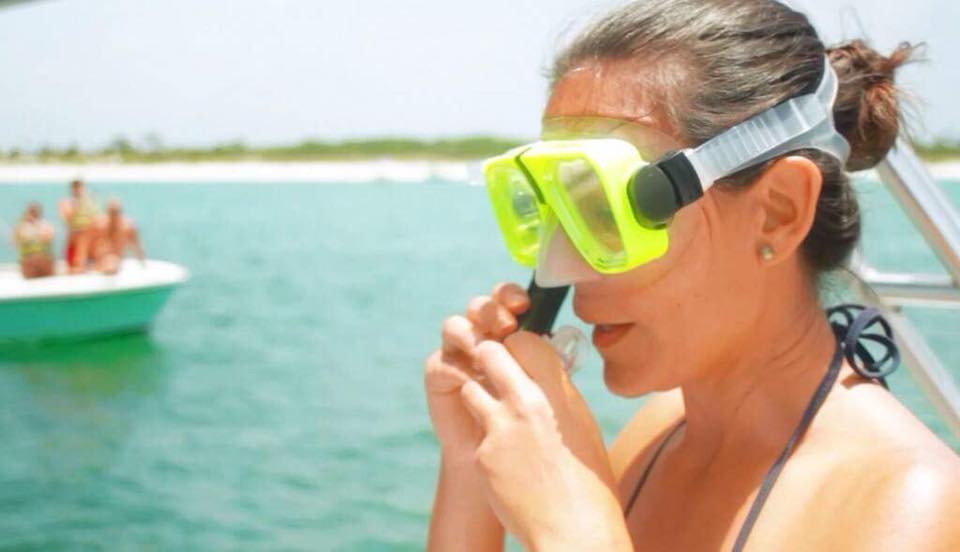
Absolutely. In fact, snorkeling is one of the best reasons to visit.
The waters around Shell Island provide several very different snorkeling environments. You have clear sandy areas, protected shallow water, seagrass flats and the rocky habitat around the St. Andrews Pass jetties. Depending on the location and conditions, snorkelers may encounter tropical and juvenile fish, rays, crabs, hermit crabs, sand dollars, sea urchins, sea stars and occasionally sea turtles.
For beginners and families, the bay side of Shell Island is usually particularly appealing. The water tends to be calmer and shallower than the open Gulf, and natural grass flats line portions of the inland side of the island.
Where Are the Best Grass-Bed Snorkeling Areas?
If your goal is to explore seagrass, focus on the protected St. Andrews Bay side of Shell Island rather than the open Gulf shoreline.
The bayside contains shallow seagrass flats and tidal areas that function as nursery habitat for marine life. Snorkeling over these grass beds is completely different from snorkeling over a sandy Gulf bottom. Slow down and look closely between the blades of grass—you may find small fish, hermit crabs, blue crabs, sea urchins and other tiny creatures that are easy to miss when swimming quickly.
Another popular area is around the Shell Island jetty and protected water behind it. The official shuttle describes this protected area as a good starting point for beginner snorkelers. From there, snorkelers can explore toward the jetty for fish, crabs and rays or move along the inland side toward the shallow grass flats of St. Andrews Bay.
The rock jetties themselves can hold considerably more marine life because the rocks provide structure and habitat. Florida State Parks notes that the nearby St. Andrews jetty functions almost like an artificial reef, attracting species including angelfish, redfish, sheepshead, rays and even octopus.
Conditions matter, though. Current, tides, visibility and boat traffic can change quickly around the pass and jetties. Families and inexperienced swimmers should favor shallow protected areas or snorkel with an experienced local captain or guide rather than venturing into moving water around the pass.
Are There Dolphins Around Shell Island?
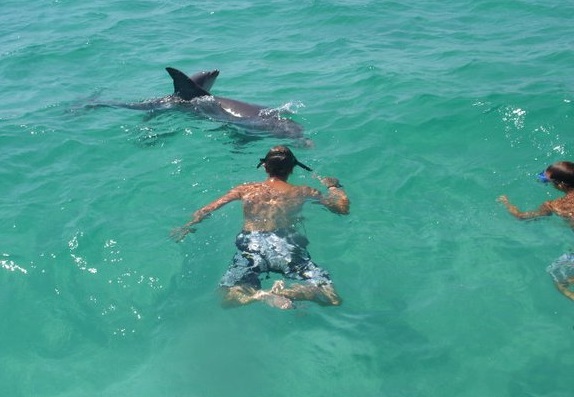
Yes—and this is one of the highlights of visiting Shell Island.
Wild bottlenose dolphins are commonly seen in the waters around Shell Island, St. Andrews Bay and the pass. Visit Panama City Beach specifically highlights bottlenose dolphins as part of the wildlife found around Shell Island, and Florida State Parks notes that dolphins also frequent the waters around the jetties.
You may see dolphins from a ferry, pontoon, snorkeling tour or even occasionally from the beach. But remember that these are wild animals, so sightings can never be guaranteed.
The best experience is to watch them behaving naturally—traveling, feeding, playing and occasionally riding boat wakes—from a respectful distance. Don’t chase, feed or attempt to touch wild dolphins.
Gulf Side or Bay Side?
One of the things we love about Shell Island is that you can experience two completely different environments within a relatively small area.
The Gulf side gives you that classic Panama City Beach look: sugar-white sand, emerald water, open horizon and waves. It’s fantastic for beach walking, swimming when conditions permit, shell hunting and simply enjoying the scenery.
The bay side is generally calmer and shallower. This is where you’ll find many of the grass flats, protected swimming areas and excellent places for families to snorkel.
On windy days, the difference can be dramatic. The Gulf may be choppy while portions of the bay side remain relatively protected. Always pay attention to local weather, currents and beach flags before swimming.
What Should Families Bring to Shell Island?
The most important thing to remember is that Shell Island is undeveloped. Don’t arrive expecting a beach bar, restaurant, restroom or convenience store.
The official ferry FAQ states that there are no restrooms, trash receptacles, picnic tables or shade pavilions on Shell Island. Visitors need to carry out what they bring.
For a family day, bring plenty of drinking water, reef-conscious sunscreen, towels, hats, sunglasses, snacks or lunch, waterproof phone protection, a small first-aid kit and something for collecting your trash. If you’re taking the ferry or renting your own boat, snorkeling equipment, flotation devices and beach toys can also be useful. A beach umbrella or other portable shade can make a huge difference during the middle of summer.
If you’re taking a guided snorkeling tour, check what is already included before packing half your vacation rental. Tours such as Island Time Sailing already provide snorkel equipment and flotation jackets, which makes packing considerably easier.
Is Shell Island Good for Kids?
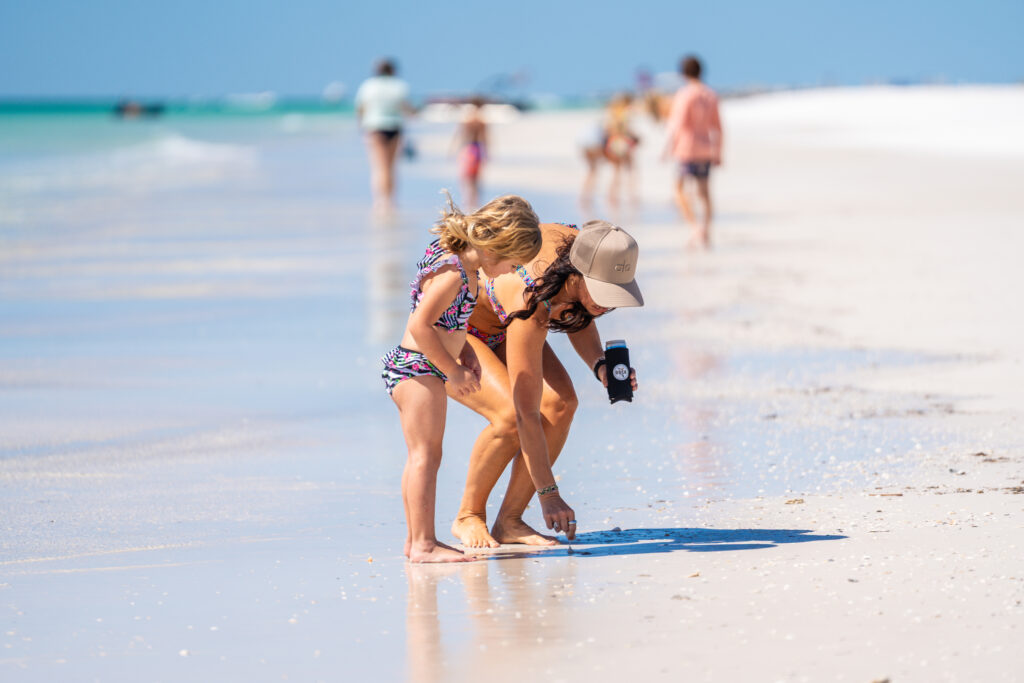
Yes, but choosing how you visit makes a big difference.
Families with younger children often appreciate the protected, shallow bayside areas. Older kids and teenagers may enjoy snorkeling, paddleboarding, dolphin watching and exploring different sections of the island more than simply sitting on the beach.
That’s another reason families should think beyond the ferry price alone. If your children are likely to get bored after an hour on the beach, an experience combining boating, dolphins, snorkeling and Shell Island may give you considerably more value.
And if your family wants to spend most of the day exploring at its own pace, a pontoon rental gives everyone room for coolers, towels, floats, snorkel equipment and all the other things families somehow manage to bring everywhere.
Is Shell Island Worth Visiting?
For most Panama City Beach visitors, absolutely.
Shell Island isn’t about amusement rides, restaurants or entertainment. Its appeal is exactly the opposite. It’s a place where the shoreline is still natural, dolphins are wild, seagrass grows beneath shallow bay water and your plans can be as simple as dropping an anchor, jumping in and seeing what you find.
The key is choosing the experience that matches your family.
If you simply want a ride to the beach, take the ferry.
If you want dolphins, snorkeling and Shell Island bundled into one easy trip, choose a guided snorkeling cruise.
If you have a family or group of four or more and want maximum freedom, compare the price of individual tickets with a pontoon rental. You may be surprised by how close the costs become—and with your own boat, the day belongs entirely to you.
However you choose to get there, bring your sunscreen, respect the wildlife, leave the island exactly as you found it and give yourself enough time to enjoy one of Panama City Beach’s most remarkable natural places.